National information resource
Find a Licensed Asbestos Tester Near You
Get asbestos testing done professionally so people are protected now and in the future — whether you are a homeowner, property manager, contractor, school, or business.
- Match request for bulk, air, or clearance testing
- Plain-language guides with cited cost ranges
- State program links from official .gov pages
- Educational site — not a testing company
Three common test types
Start here, then open a guide for process, costs, and why accreditation matters.
Bulk material sampling
Bulk sampling tests building materials — insulation, floor tile, ceiling texture, siding, and more — in a lab to see if they contain asbestos before you renovate or demolish.
Read guide →Asbestos air testing
Air testing measures fibers in the air during or after disturbance or abatement. Method choice (PCM or TEM) depends on the project and applicable rules.
Read guide →Clearance testing
Clearance testing checks whether an abatement area is ready for re-occupancy. It is a professional process — not a home test kit.
Read guide →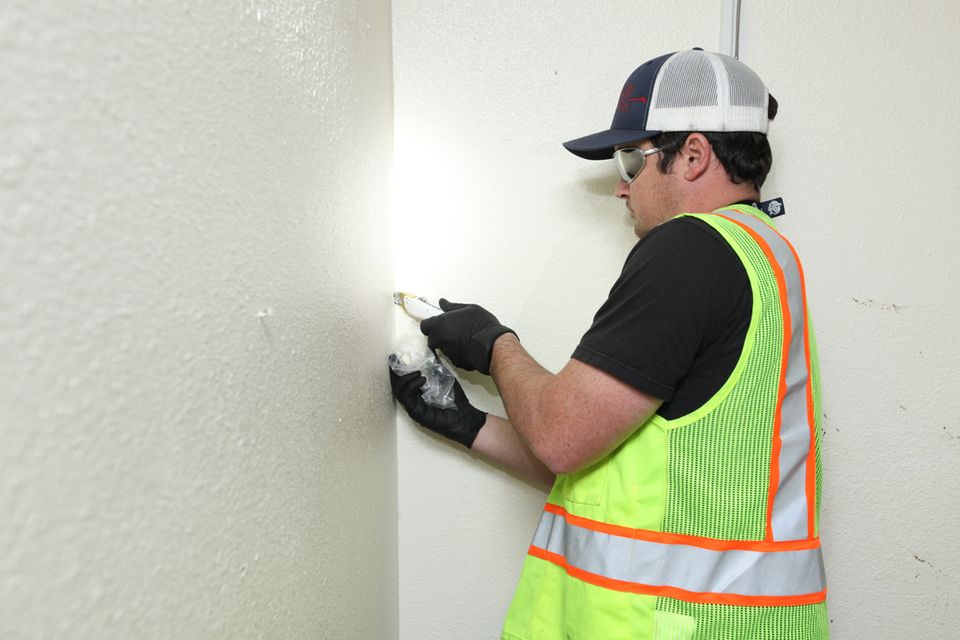
What a professional bulk sample looks like
A trained inspector collects a small piece of each suspect material with controls to limit fiber release, then sends it to an accredited lab. Rules on who may sample differ by state — New York requires certified inspectors working for a licensed firm, while Maryland’s homeowner FAQ allows homeowners to sample.
New York survey rules · Massachusetts · Connecticut · Maryland
Licensing differs too: Pennsylvania certifies each inspector and publishes a daily license list, while New Jersey has no state inspector certification requirement. Ohio calls its inspectors evaluation specialists, and Indiana exempts most owner-occupied homes from IDEM inspection rules. Kentucky, Alabama, and Mississippi also have four-unit home exemptions, with different local and development-project catches. Illinois splits NESHAP notices (Illinois EPA) from licensing (IDPH), and Cook County still requires a permit for residential asbestos work.
Common asbestos materials checklist
EPA and state agencies list these as places asbestos may be found. Checking a box does not mean the material in your building contains asbestos — only a laboratory analysis can determine that. Use this list to brief a licensed inspector, then request a match below.
Sources: EPA — Learn About Asbestos (where asbestos may be found); EPA — Protect Your Family; Maine DEP inspection FAQ and Rhode Island homeowner asbestos page, cited on those state pages.
0 material types selected.
A licensed inspector can sample the items you care about and send them to an accredited lab. We are an educational match service, not a testing company.
Check any materials you are worried about. A short summary and match button will appear here.
Do I need asbestos testing?
Answer three questions. The result cites EPA’s “don’t disturb it — use a trained and accredited professional” guidance, plus the federal NESHAP inspection trigger. It is educational, not a legal determination.
If you are planning to remodel, do not assume the work is risk-free. EPA’s homeowner guidance says remodeling can disturb building materials and that a trained and accredited asbestos professional should take samples for analysis. EPA also says taking samples yourself is not recommended, because sampling done incorrectly can be more hazardous than leaving the material alone.
Federal Asbestos NESHAP rules require a thorough inspection where demolition or renovation will occur at a facility — structures, installations, and buildings, excluding residential buildings that have four or fewer dwelling units. Any demolition or renovation at an institutional, commercial, or industrial building is regulated; at a minimum the thorough inspection requirement applies. The owner or operator must notify the delegated agency (often the state) before any demolition, and before renovations of buildings that contain a threshold amount of regulated asbestos-containing material. NESHAP does not require regulated ACM to be removed before demolition or renovation if the total amount to be removed or disturbed is less than 260 linear feet, 160 square feet, or 35 cubic feet. Houses demolished as part of a commercial or public project are not treated as exempt. Your state can be stricter than this federal floor — read the state notes below.
EPA says that if building materials in your home are not damaged and will not be disturbed, you do not need to have the home tested for asbestos. Material that is in good condition and will not be disturbed (by remodeling, for example) should be left alone.
For an owner-occupied home, start with EPA’s rule of thumb: leave undamaged material alone, and use a trained and accredited professional if you will remodel or if material is more than slightly damaged (Protect Your Family from Exposures to Asbestos). State licensing, inspection, and notification rules can still apply when a contractor does the work or when you renovate — check your state page.
Rental housing and apartments are often treated more strictly than an owner-occupied single-family home. Landlords, property managers, and contractors more often need a licensed inspector and a licensed abatement contractor. OSHA regulates asbestos in construction and general industry; Maine DEP notes that OSHA rules apply whenever an employer/employee relationship exists. Read your state’s rental and multi-unit notes on this page.
EPA’s Asbestos NESHAP page states that any demolition or renovation operation at an institutional, commercial, or industrial building is regulated, and that at a minimum the thorough inspection requirement applies. Schools have extra duties under AHERA: inspections and response actions must be done by professionals trained under EPA’s Model Accreditation Plan, and school bulk samples and TEM clearance air samples must go to a NIST NVLAP-accredited laboratory. EPA also recommends accredited labs for non-school buildings.
EPA says asbestos-containing materials that are not damaged or disturbed are not likely to pose a health risk, and that the best step is usually to leave material alone if it is in good condition. Do leave undamaged asbestos-containing materials alone, and take every precaution to avoid damaging them.
If you suspect a material contains asbestos, EPA says not to touch it. Look for signs of wear or damage such as tears, abrasions, or water damage. Damaged material may release fibers, especially if it is hit, rubbed, handled, or exposed to vibration or airflow. If the material is more than slightly damaged, or you are going to make changes that might disturb it, repair or removal by a trained and accredited asbestos professional is needed.
EPA’s homeowner don’ts include: don’t dust, sweep, or vacuum debris that may contain asbestos; don’t saw, sand, scrape, or drill holes in asbestos-containing materials; and don’t use abrasive pads or a power stripper on flooring that may contain asbestos.
When federal rules call for an inspection
EPA's Asbestos NESHAP page explains that Clean Air Act air-toxics rules specify work practices for asbestos during demolitions and renovations of facilities - structures, installations, and buildings, excluding residential buildings that have four or fewer dwelling units. The regulations require a thorough inspection where the demolition or renovation will occur. The owner or operator must notify the delegated agency (often the state) before any demolition, and before renovations of buildings that contain a threshold amount of regulated asbestos-containing material.
Any demolition or renovation at an institutional, commercial, or industrial building is regulated; at a minimum the thorough inspection requirement applies. NESHAP does not require regulated ACM to be removed before demolition or renovation if the total amount to be removed or disturbed is less than 260 linear feet, 160 square feet, or 35 cubic feet. Houses demolished as part of an urban-renewal, highway, shopping-mall, industrial, or other private-development project are not treated as exempt. Isolated single-family homes have a separate 1995 EPA clarification linked from that page.
OSHA regulates asbestos in construction and general industry. Many state pages on this site note that OSHA rules apply whenever an employer/employee relationship exists. State programs can be stricter than the federal floor - New Hampshire, for example, requires an inspector before renovation of ordinary homes unless a narrow exception applies. Use the state list for the rules that govern your building.
EPA's common list of where asbestos may be found includes vermiculite attic and wall insulation, vinyl floor tiles and sheet-flooring backing and adhesives, roofing and siding shingles, textured paint and patching compounds, pipe wrap and furnace gaskets, and asbestos cement products (Learn About Asbestos). The checklist above turns that list into something you can hand to an inspector.
Why DIY asbestos kits fall short
EPA says a trained and accredited asbestos professional should take samples, because a professional knows what to look for and because there may be an increased health risk if fibers are released. In fact, if done incorrectly, sampling can be more hazardous than leaving the material alone. Taking samples yourself is not recommended.
If materials are not damaged and will not be disturbed, EPA says you do not need to have your home tested - leave them alone. If you are remodeling, or materials are more than slightly damaged, repair or removal (and the sampling that comes first) belongs with a trained and accredited professional.
DIY kits also cannot replace clearance testing after abatement. Clearance is a visual inspection plus air samples analyzed by an accredited lab under the method required for the project, often by someone independent of the contractor. For school work, EPA requires NVLAP-accredited labs for bulk analysis and for TEM final clearance air analysis, and recommends accredited labs for other buildings.
Protect people with professional testing
Disturbing suspect materials without knowing what’s in them can put households and job sites at risk. Use a licensed or accredited professional and an accredited lab.
Who needs asbestos testing?
Rules differ by building type and state — but the goal is the same: know what’s there before you disturb it.
Homeowners
Older homes may contain asbestos in insulation, flooring, ceilings, siding, and more. Testing before renovation or demolition helps you plan safely and follow state notification rules where they apply.
Companies & institutions
Property managers, contractors, schools, and businesses often need licensed inspectors, project monitors, notifications, and clearance testing. Check your state agency links before work starts.
States
East Coast first, then working west. Live state pages link only to verified official sources. Others are listed as coming soon.
Live state guides: Maine · New Hampshire · Massachusetts · Rhode Island · Connecticut · New York · New Jersey · Pennsylvania · Delaware · Maryland · Virginia · North Carolina · South Carolina · Georgia · Florida · Vermont · West Virginia · Ohio · Michigan · Indiana · Kentucky · Tennessee · Alabama · Mississippi · Illinois
- Maine
- New Hampshire
- Massachusetts
- Rhode Island
- Connecticut
- New York
- New Jersey
- Pennsylvania
- Delaware
- Maryland
- Virginia
- North Carolina
- South Carolina
- Georgia
- Florida
- Vermont
- West Virginia
- Ohio
- Michigan
- Indiana
- Kentucky
- Tennessee
- Alabama
- Mississippi
- Illinois
- Wisconsin — coming soon
- Minnesota — coming soon
- Iowa — coming soon
- Missouri — coming soon
- Arkansas — coming soon
- Louisiana — coming soon
- North Dakota — coming soon
- South Dakota — coming soon
- Nebraska — coming soon
- Kansas — coming soon
- Oklahoma — coming soon
- Texas — coming soon
- Montana — coming soon
- Wyoming — coming soon
- Colorado — coming soon
- New Mexico — coming soon
- Idaho — coming soon
- Utah — coming soon
- Arizona — coming soon
- Washington — coming soon
- Oregon — coming soon
- Nevada — coming soon
- California — coming soon
- Alaska — coming soon
- Hawaii — coming soon
FAQ
Is this site an asbestos testing company?
No. This is an educational information resource. We help you understand testing types and state rules, and we can match you with a licensed asbestos tester through the form. We do not perform sampling or lab analysis ourselves.
What kinds of asbestos tests are there?
Common types include bulk material sampling, air testing (often PCM or TEM), and clearance testing after abatement. The right choice depends on your building and project.
How much does asbestos testing cost?
According to Angi (2026 data), professional asbestos testing often averages about $483, with many projects in roughly the $231–$776 range. Air testing is commonly listed around $200–$800. Your actual price depends on samples, access, and location.
Should I use a DIY asbestos kit?
EPA says a trained and accredited asbestos professional should take samples, and that taking samples yourself is not recommended because incorrect sampling can be more hazardous than leaving the material alone. DIY kits are also not a substitute for professional clearance after abatement. For renovation, demolition, schools, and clearance, use licensed or accredited professionals and accredited labs. See EPA — Protect Your Family.
When does federal law require an asbestos inspection?
The Asbestos NESHAP requires a thorough inspection where demolition or renovation of a facility will occur. Facilities include structures, installations, and buildings, excluding residential buildings with four or fewer dwelling units. Any demolition or renovation at an institutional, commercial, or industrial building is regulated; at a minimum the inspection requirement applies. The owner or operator must notify the delegated agency before any demolition, and before renovations over a threshold amount of regulated asbestos-containing material. States can be stricter. See EPA’s NESHAP overview and your state page.
Which states do you cover?
We are building state pages East Coast first, then west. Live now: Maine, New Hampshire, Massachusetts, Rhode Island, Connecticut, New York, New Jersey, Pennsylvania, Delaware, Maryland, Virginia, North Carolina, South Carolina, Georgia, Florida, Vermont, West Virginia, Ohio, Michigan, Indiana, Kentucky, Tennessee, Alabama, Mississippi, and Illinois. Other states are listed as coming soon.
Who needs asbestos testing — homeowners or companies?
Both. Homeowners often need testing before renovation. Property managers, contractors, schools, and businesses often face inspection, notification, and clearance rules. See your state page for agency links.
Why do accredited labs matter?
For AHERA school work, EPA requires laboratories accredited under NIST’s NVLAP for bulk analysis and TEM final clearance air analysis. EPA also recommends accredited labs for non-school buildings. See EPA Asbestos Professionals.
How do I get matched with a licensed tester?
Use the form on this site with your name, contact info, ZIP/state, whether you are a homeowner or business, and the test type you need. We use that information only to respond to your request.